Security Best Practices for Developing and Deploying Cloud-Native Applications

Introduction

While cloud services have made application development more scalable and flexible, startup founders have been reluctant to adopt cloud-native environments due to inherent security risks. 

This blog aims to answer the questions that startup founders have about best practices in cloud-native application(s) security, how these practices are implemented and overseen in the cloud, and what benefits they can provide for a startup. You can sleep soundly knowing that all aspects of your application development security are covered.

What Is the Difference Between Traditional Application Security and Cloud-Native Security?

In traditional applications before the cloud, development and security requirements were fulfilled by teams of developers. Infrastructure management was managed by a different team but end-to-end securing of the network, compute, and storage was ensured by developers. This required more manpower, processes, and policies such as setting up hardware firewalls, DDOS mitigations on-prem, etc. 

With the advent of the cloud and its security, the only important thing is the context of operation for your application. Surely, the cloud has a lot to offer in terms of flexibility along with a range of services and infrastructure. However, these features also enlarge the attack surface area in order of magnitude as compared to traditional application security. In light of this, understanding the context in which your application is operating becomes crucial because now you need to model your application while understanding its input/output patterns, interaction pieces, etc. Your applications may have inputs from event streams, cloud storage changes, and databases, potentially introducing additional attack vectors. Hence, you must secure the platform and the infrastructure that enables your application. Only this kind of thorough and continuous hardening would implement application security in a cloud-native environment.

Does This Imply That the Advent of the Cloud Has Made Security More Difficult Rather Than Easy?

It hasn’t made security difficult per se; however, the advent of the cloud has instituted the concept of Shared Responsibility.

As mentioned earlier, traditional application development, infrastructure, and security were managed by on-prem IT teams but with the cloud, some of those responsibilities have been outsourced to the Cloud Service Providers (CSPs) who are responsible to secure their infrastructure and software layers that they operate on, formally known as Inherited Security Controls, that covers the security from CSPs’ side. 

For the startups using these services, the responsibility to secure their domain lies with themselves. For example, configuration management, identity and access management policy, securing databases, data encryption in-transit and in-rest, etc. 

CSPs provide you with tools to secure your domain. The ultimate responsibility lies with you in the Shared Responsibility Model to administer the right configurations and apply the right guard rails at each layer. 

Cloud has not made security difficult. Instead, it has divided the responsibility between the service providers and startups to ensure robust and secure applications. 

How Would You Describe a Secure Software Development Lifecycle?

To secure any software development lifecycle (SDLC), having third-party APIs or open-source libraries is no longer enough. Instead, security has to be catered to at every stage of the software development lifecycle. It is ideal to have a secure automated testing pipeline built into all stages of SDLC of your application.


For cloud-native security, however, you need to protect all of the assets that you have deployed on the cloud. This requires, first of all, understanding the context and substrate your application operates in e.g. containers or VMS. Ensuring security at Operating Systems (OS) and application levels requires administering good principles and policies. 

Firstly, Static Application Security Testing (SAST) which is built into the CI/CD pipeline allows developers to statically analyze vulnerabilities in their source code and the third-party libraries. 

Secondly, Dynamic Application Security Testing (DAST) also known as penetration testing is carried out once the application has been deployed. It allows the developers to scan the ports and IPs of your space, anything that is open and vulnerable. Once identified, you can take measures to mitigate it. 

Thirdly, Interactive Application Static Testing IAST resembles DAST in operating dynamically. However, the goal of IAST is to find out runtime vulnerabilities in a runtime scanning infrastructure that continuously scans and monitors your environment. 

Lastly and more recently, Runtime Application Self-Protection (RASP) where your applications are built in a way (or are supported by services) that essentially detect these issues that happen at runtime and then do self-mitigating actions, generate real-time alerts if something suspicious has happened. For example, say there’s a DDoS going on, how to detect and automatically remediate it. This is what falls under RASP. 

All of these measures together contribute to creating a secure development lifecycle for an application.

What Are the Best Practices for Secure Application Development and Deployment?

For ironclad secure application development, Identity and Access Management (IAM), encryption, threat monitoring response, data privacy and compliance, and automated security testing are major boxes that need to be checked irrespective of what cloud you are going to deploy online. 

For Identity and Access Management, the principle of Zero Trust is followed which means you should not trust anyone. You have to model your application with knowledge of who is going to access it, and what is the level of privileges they have. CSPs give you tools to implement these identities and access management.

The importance of data encryption is undisputed. There are different types of data encryptions namely, in-transit, in-rest, and in-use. In-transit, in-rest and in-use encryptions help protect your data during communication, when data is stored/is at rest, and when data is operated on, respectively.

For threat monitoring and incident response, you need to have an infrastructure in place that continuously scans and monitors for threats. Once a threat is detected, you must have a strategy in place to respond to that threat. If these strategies are an afterthought for a startup, they can expect a huge blast radius when they are hit with a threat. So, detection and response to security-related incidents are critical. 

Data privacy and compliance deal with different localities, regulations, and laws that apply to these local sites. The data privacy and compliance mechanisms in your application have to identify and address these differences depending on your location and the location of your CSPs.  

The necessity of Automated Security Testing cannot be stressed enough and it implies that ideally at each stage of SDLC, you have all of the controls i.e. SAST, DAST, and RASP have been built in the CI/CD pipeline. 

Lastly, securing your APIs and secure modeling of the communications patterns that your application exhibits is really important as well. 

Is Monolithic Architecture More Secure Than Microservice Architecture?

Monolithic architecture is a single-tier design with security parameters built around that tier. This might make securing that one tier relatively easy, but monoliths have their disadvantages. For example, you cannot innovate fast enough, or add new features efficiently. Whereas, microservices architecture can decouple the responsibility of each service and is iteratively able to improve and consequently upgrade your product fast. Modern architecture requires you to have that very fast prototyping and development and no matter how secure monoliths may be, microservices are the future. 

Does all the data need to be encrypted?

Ideally, yes! But, of course, there are costs associated with it.

When you encrypt data at rest, it requires additional resources in terms of time and money for ensuring the cryptographic validity of your data. The overhead extends to performance as well because encryption requires decryption. So, your encryption scope is defined by the context your application is operating in. You have to strike a balance between performance and data security. 

How Is DevOps Different From DevSecOps?

DevSecOps is just a subset of DevOps. The concepts differ in the notion that DevOps is purely just CI/CD and IaC allows you to rapidly develop applications and deploy them whereas DevSecOps deals with automated security testing that is built into the pipelines resulting in development and security operations. On one hand, DevOps facilitates the configuration of your IaC and on the other, DevSecOps facilitates the additional guardrails built for security-specific functions. That is where the industry normally decouples the concepts of DevOps and DevSecOps in the application’s continuous integration and deployment. 

A right DevOps pipeline must have security built-in, it can’t be an afterthought. DevSecOps directly targets the security-specific things in a DevOps pipeline and a DevOps pipeline is essentially just the application’s continuous integration and deployment.

Does Cloud-Native Security Mitigate Insider Threats?

Insider threats are a vast and interesting domain as there are models that can be used to predict them but mostly they are very hard to find. Insider threat means that you either have some unauthorized user who has their privilege elevated or there is some malicious insider who essentially has access to data and has somehow exported it out.

Cloud-native security provides you with the tools to mitigate insider threats. For example, you can set up the right access identity and access management and follow the principle of least privilege where the people who are supposed to have access to that data are the ones who do, and then you can also establish parameters around services. You have, at your disposal, tools to implement these controls but insider threats will still happen and you need to have a robust incident management detection and response strategy to deal with that. 

How to Ensure Long-Term Data Safety in the Case of Cloud Payment Applications?

For payment industry solutions, there is a specific standard called Payment Card Industry Data Security Standard (PCI DSS). It has checklists of principles that are implemented for any application that provides a payment solution. For example, it includes having active firewalls, the right IAM, the encryption in place, and protecting the cardholder. Any application that is being built with a payment feature has to abide by these standards. What is important to note here is that with the increasing amount of CSPs in the market, all of them ensure that their services are PCI DSS compliant. Still, as an application developer or a startup founder, you have to make sure that you have the right vetting in place to guarantee standard compliance. 

Is Cloud Security Offered by Cloud Service Providers (CSPs) Enough for Your Application?

CSPs will ensure their layers of software, hardware, and infrastructure are secure and any breach in those layers will be their responsibility. Keeping Shared Responsibility Model in mind, the second layer is the domain of the startup using the services. Therefore, securing that layer is the responsibility of the startup itself. For example, robust IAM strategy, patch management, and configuration management need to be secured by your company to deter exploits. 

How Do I Secure Hybrid and Multi-Cloud Environments?

Hybrid environments are a challenge because there are different tools for on-prem and cloud to implement security. Ideally, there would be a single dashboard to store, operate, and monitor such environments. CSPs have been increasingly providing features for a seamless experience across different environments. For example, Google has Anthos where you can run the Kubernetes engine on-prem as well as on the cloud at the same time and have a single pane of management across them. Similarly, AWS has AWS Outposts which allows you to use AWS stack and services on-prem as well. The important thing to note here is knowing the context; what are the communication patterns that exist on-prem, what are the communication patterns that exist on the cloud, how do you secure them, can you have one solution that spans across both or will you have to have different solutions that logically create a single security interface but are decoupled in physical implementation? 


How Is Application Security Guaranteed in a Multi-Geo Environment?

In the shared responsibility model, the third layer is customer-specific and depends on the operation site of your application. For example, the Global Data Protection Regulation (GDPR) standards and protocols need to be followed for customer data stored in Europe. According to their data regulations or their environmental regulations, this data cannot move out of said location. So if you are developing an application that spans different geographies, the tools to implement security guardrails are available but a robust strategy to develop an end-to-end secure application that operates in different jurisdictions and has different governing laws has to be formulated by the startups.  

What Should Be the Course of Action in Case the Breach Has Happened?

There are a few standardized steps, for example, you have to capture events in your system and analyze them. You need to know not only the source IP of the malicious request but also the destination IP, the protocol, and the fields inside these requests. There are different ways to address a breach. Some startups build in-house solutions that define the rules that are applicable for such events. Analyzing and mapping these events to normal traffic generates alerts. The incident response team has automated pipelines in place to identify and launch actions that address said alerts. Generally, continuous threat monitoring and incident response are one of the very critical functions of having security in this day and age. 

In Proactive Security Strategies, Does Artificial Intelligence (AI) Play a Role?

Proactive security detection means automated security testing throughout your SDLC. Tools are available that allow you to continuously scan your Static Source Code to find out vulnerabilities and then automatically suggest solutions to mitigate those vulnerabilities. Similarly, Dynamic Code Analysis and Runtime Code Analysis allow you to map traffic patterns so that you can identify any anomaly. AI models help you predict these patterns and identify anomalies. This, in itself, is a vast domain and AI plays a role in contextualizing the full security problem.
To Watch the Complete Episode, Please Click on This YouTube Link:

https://www.youtube.com/watch?v=hPT1Zj3tNV4&t

Read more

Improve Operations, Performance, and Business Metrics with Application Monitoring Solutions

Enhanced user experience is one of the top goals for every SaaS provider. How do you ensure that your customers are experiencing the value you intended your applications to deliver? 

“Customer experience is the next competitive battleground.”

– Jerry Gregoire (the founder and Chairman of Redbird Flight Simulations, Inc.)

Having real-time, non-real-time and partially real-time metrics at your fingertips may help you to stay ahead of expected and unexpected challenges regarding your service performance, business, and operations.  

Why do startups need to monitor their well-tested applications?

Earlier, the software was delivered (or “shipped”) to the customers through a CD and that was the extent of it. The job of the software service provider was completed. However, since the advent of the SaaS and the cloud services, the software developers have visual access to more information about the delivered application, for instance, how customers are using it, which feature is popular with the user, which feature is unpopular among the users, and much more.

This allows the SaaS providers to leave the hardware mindset behind, they no longer have to ‘build it to never break’. Instead, the application monitoring allows SaaS providers to make customer satisfaction an iterative process for a product. Why?  Because application monitoring allows you to not only track the performance of your product in the customer environment but also the oversight of operations and some valuable business insights that you can leverage to enhance your revenues. 

What are the different categories of metrics used to monitor such applications?

Broadly, the application monitoring metrics are divided into three categories.

The first and most important one is operational metrics. Generally, it covers the health of your services, all the related underlying microservices, and the interaction of the service in its environment. Operational metrics are usually real-time metrics that notify SaaS providers as soon as an application or any feature in the application ceases to function.  

The second category of metrics is business metrics which determine if your service is offering the value that you designed it to offer. Business metrics can be real-time metrics but they usually are not. They are measured over weeks and months to identify a trend. 

The third type of metric is performance metrics. An application may be running and providing the value it was meant to, but it may be taking a long time to load, or TCP handshake is taking longer than expected, such measurements are defined by the performance metrics of the application. Performance metrics are semi-real-time metrics. 

What are some good examples of operational metrics?

The basic metrics that SaaS providers can use for monitoring applications like operationality, CPU memory, or I/O usage are offered by the cloud for free. These are also metrics that don’t require any instrumentation in your code.

There are instances where metrics are measured through the use of instrumentation installed in your application. If the code crashes, these instrumentations will generate an alert for the undesired event across multiple microservices. 

Metrics that are threshold-based and can generate a notification and/or when the threshold is breached are also used in operations depending on your services. 

Operational metrics are layered in that order that you start small and add sophisticated metrics over that foundation. 

What are some top-tier performance metrics for application monitoring?

Page load time is a good example of how you measure the performance of your service. Similarly the time it takes the customer to submit a form hosted on your website is another. The time it takes for my ride-hailing app to enter an address and then the time difference to when the cab driver receives the notification are all performance measurements that vary depending on your service. 

For more sophisticated monitoring, metrics such as upon notification of an error, observing performance at a more granular level like TCP handshake time and SSL time, etc. are incorporated and you gradually build on top of simpler metrics. 

Does microservices architecture pose more complexity compared to a monolithic architecture?

Microservices may be harder to build but are easier to monitor because the metric that is experiencing error will have the issue limited to that microservice alone. 

Monolith applications are easier to build but are harder to monitor, simply because if something is rendered defective, debugging and addressing the problem can be very time-consuming and will affect every aspect of your business. 

What are your recommendations regarding an alert system?

The Cloudwatch monitoring and observability solution for application and infrastructure by Amazon is a very powerful system. There are multiple alerting tools like email notifications, SNS, and SQL notifications that are built into it. It also offers multiple ticketing as well as communication system integrations, on-call tools, PagerDuty, and much more. 

Other than that, Google Cloud MonitoringDataDog, and New Relic are a few SaaS providers of Monitoring Solutions. 


How do monitoring solutions help operations teams with correlation, triage, and root cause diagnosis?

As a SaaS service provider, you ought to know about a problem in your service or application before or when the customer complains. One application is supported by multiple microservices and identification of the performance issue and knowing where to find that issue before you can resolve it, is only possible through metrics for monitoring applications. 

Once you have identified the problem and its source of a performance bottleneck, you can start fixing that problem to bring the application back to its original functional state and that’s how triage, correlation, and root cause diagnosis help you with identification, mediating the problem, and keeping your service functional.  

Are there monitoring solutions where you are proactively looking and might foresee an event?

As a SaaS-based startup, your software stack is missing a key monitoring aspect if your system was unable to alert you hours ahead of your customer. Your customer informing you about an error should be the last resort. Usually, this last resort is seen in instances where SaaS providers missed or misjudged some metric and deemed it irrelevant once it broke in the customer environment and you weren’t notified. SaaS providers need to carefully choose their monitoring deck to avoid this oversight and monitoring needs to be done proactively rather than reactively. 

How much should the cost be for any application monitoring solution?

Cloudwatch, on-call rotation systems, and other metrics are not super expensive but can get expensive as your application scales and requires more and more components.  The human resources may be expensive, however, the actual dollar cost of setting up monitoring systems is generally pretty low. 

How do we monitor API endpoints?

For APIs, I always suggest canaries, simply because it is the easiest, fastest, and painless way to monitor your API endpoints. Every public-facing API should have multiple canaries that are continually testing it. There are numerous tools available, in the market, by cloud providers and third-party providers for testing API endpoints, in terms of security testing, function, and performance testing. 

Cloudwatch uses the concept of synthetics that allows you to set up a synthetic stack in another region from where you can continuously test your public API endpoints. 

How does a startup founder go about setting up a monitoring system and which tools are the best ones for it?

As a startup founder, it is easy to fall for the idea that more data means more results. I would caution against it and instead suggest starting small. For instance, start with CPU memory, focus on mechanisms and processes, and make a trial of when things might break. Install solutions for those points. Start with a few metrics preferably that can fill in one single screen and then focus on your mechanisms, your backend system, your paging, and the culture of operational excellence rather than the metrics themselves. Once you have achieved that successfully without oversights, evolve from there. 

What is the difference between agent-based and agentless monitoring?

In agentless monitoring, an agent is not required to be installed in the system for you to be able to monitor it. Systems that already exist emit those metrics automatically. Agent-based monitoring requires an agent to be installed when you integrate with an SDK and that agent collects all the desired metrics and emits them to your application backend. I recommend agentless monitoring but it can only take you so far. The agent-based approach provides much deeper insights. Take application performance monitoring as an example. Here, agent-based monitoring can allow you to passively monitor dom objects and measure the page load time via a short script that allows you to observe which part of the TCP handshake is taking longer, and so forth. 

This depends on how deep you want to observe the operations or performance and also on the feasibility of inserting an agent-based solution. 

What good vs. bad monitoring practices do you see in the market and what does the future look like for Monitoring Solutions?

For now, there are two strategies in the market: the new way of shipping software with monitoring and observability services vs. the old way of shipping systems that never break. For me, technology is easy, the people are the hardest part of the puzzle. But I have noticed that startups are stuck in legacy practices of not having visibility to their customer environment and their service performance. 

And as far as the future is concerned, the practice of monitoring your application is the future, where you can measure performance metrics, supervise the operational metrics of your application and observe business metrics for what features are providing value and which are not. All these metrics provide you with significant data to make agile decisions for your startup. All successful companies today, as well as in the future, will have these metrics and will be able to look each other in the eye and say we made a mistake and we’re going to change it because the data tells us otherwise. I think such courageous teams are winning today and they will continue to win in the future as well.

Read more

Supercharge your Product Development with Infrastructure as Code

Infrastructure as Code (IaC) is a dynamic and automated foundation for DevOps. But, as a startup founder, how much do you really know about IaC? 

We invited Abdullah Shah, Senior Software Engineer working with the Cloud Security Engineering Team at Salesforce, to enlighten us about IaC. Here is how it went down:

Why is there a need for IaC? What trouble will companies face if they don’t embrace IaC?

Without IaC, the IT infrastructure is configured, operated, and maintained manually. Historically, applications were developed using legacy IT infrastructure i.e. servers, storage, and compute. All these functions were provided using bare metal hardware in an on-prem environment. The configuration, operation, and maintenance were manually performed which meant high rates of human errors, delays, and demand for shedload members on the IT team. In addition, these manual processes exhibited lack of standardization of procedures and ineffective documentation, if at all. Collectively, this resulted not only in Environmental Drift but overall an inconsistent environment for application development and created even more challenges during scale-ups. 

Explain to us the concept of IaC, and why should the companies work with it? 

The irregularities we discussed in the absence of IaC, necessitate a more sophisticated solution for infrastructure to develop products. Infrastructure as Code (IaC) is that very revolution. 

IaC, in contrast to the legacy manual model, is a more descriptive model which allows the configuration, provision, and management of infrastructure using machine-readable files.

infrastructure as code
Infrastructure as Code

With automated Infrastructure, configuration, operations, and maintenance functions are now performed using scripts. As a result, IaC gives you performance consistency, monitoring accountability, operations agility, scale-up flexibility,  audit transparency, software security, and a much faster development cycle. Companies that have embraced IaC benefit from reduced operations costs and rapid time to market new products, services, and features. All in all, higher revenue and more satisfied customers. 

As a Start Up founder, what steps do I need to take to embrace IaC?

I would advise promptly embracing IaC or at least outlining the roadmap to immediately focus on embracing it. 

The first step is to evaluate the infrastructure requirements for the products and/or services you offer. Secondly, with multiple options available, make a categorical decision on your tech stack according to your product. 

Startups usually want to build and push products to the market rather quickly since they believe it’s merely prototype(s). However, I would encourage you to create a solid foundation with the right IaC principles and to implement IaC from the ground up. With a strong footing, scaling beyond the first 2- 3 servers will become streamlined and efficient with IaC. 

Is IaC required to have DevOps in a Start Up? How are they related? 

DevOps and IaC go hand in hand. One would not exist without the other. Although all companies apply the DevOps principles to varying degrees, the most popular is the Shift Left approach which is synonymous with the service ownership model. The idea is that the developers in IT teams are not working in silos but collaboratively, to create a holistic view of the entire application development lifecycle. In this spirit, developers are not only responsible for application development but also for creating the right infrastructure for the operations and deployment of the application as well. This means that the responsibility of coding has been fanned out among the IT team members. Testing and monitoring roles have been shifted left to the developers and all of this is enabled by IaC. 

Do I need to test and monitor IaC?

There is no substitute for testing and monitoring IaC; it practices more stringent test requirements. Infrastructure can be automated flawlessly with the use of correct IaC templates and avoiding misconfigurations. An array of testing tools are available for you to choose but the fundamental notion of testing being critical, for IaC, cannot be overstated.

With QA functions disappearing in pure DevOps culture, who would carry out these stringent testing and monitoring?

In pure DevOps, CI/CD has automated IT testing and operations which in turn accelerates the process of application deployment exponentially. This results in continuous updates to your application and infrastructure. Now, if you don’t have automated testing, you are in a heap of trouble. At this rate of deployment, humans can not keep up and companies must implement automated testing strategies throughout the application development supply chain. 

How would you address the IaC related fear of automation, in industry?

The idea is simple. If you anticipate failure, you can prepare for it and then mitigate it. The preparation you need is to implement a robust testing strategy and it is equally important to have a control feedback loop to continuously audit the strategy and improve. The ultimate goal is the provision of the right environment that doesn’t miss any build failures. Failures, caught and addressed in the next loop, will allow streamlined product deployment moving forward. 

Explain the difference between declarative and imperative approaches for us.

The difference is that Declarative is a functional approach and Imperative is a procedural one. Declarative IaC approach answers the question ‘What is the preferred state’ and Imperative IaC approach answers the question ‘How is the preferred state achieved’’. Since it is critical to maintain your infrastructure in the desired state, it is recommended to use a declarative IaC approach. Imperative IaC approach relies on control loops and conditional statements which can become a complex endeavor. 


Some supporting tools are available that create an imperative layer over the declarative model to provide an abstraction. Pulumi, for instance, is one such tool that is self declarative and can provide an imperative layer. Amazon CDK and Terraform are other examples of such tools that provide the best of both approaches. 

Which of these approaches in your opinion can help the companies with their tech debt?

Traditional practices slow down the application development cycle and can lead to technical debts. In unpredictable cases e.g. immediate customer requirement, badly written code, or new feature request, the right automated testing strategies are your only way out of incurring technical debt. That is exactly what IaC promises. It creates those guard rails around your processes that reduce technical debt. 

Mutable and Immutable infrastructures, which one would you recommend? 

During application development, changes are inevitable. Your infrastructure will need to be scaled up or down, updated, and/or patches will have to be applied. Post-deployment, if the infrastructure can be changed, it is mutable infrastructure and vice versa. In case of immutable infrastructure, the changes are rolled out on a replica new machine before the old immutable infrastructure is taken down. There are multiple ways to go about it. However, when in doubt, go with mutable infrastructure. 

In terms of tech stack, what are the best tools to implement IaC?

There is a spectrum of choices available, as discussed earlier. Amazon CDK, CDKFT, CloudFormation, Terraform, and Pulumi are all tools used to implement IaC. I suggest democratizing the decision among developers, SREs, and stakeholders since tech stack is not only meant for IaC but the entire application development pipeline is orchestrated. For developers, you have version control using Git; for operations CI/CD, AWS pipeline, GitOps; for code build service, there are custom Jenkins tools. Argo CD is a popular tool that operates specifically with Kubernetes-based deployments while Spinnaker allows you to deploy custom IaC technologies. However, the decision depends on your use cases and what is required to implement them.

My recommendation for IaC, is Terraform, as they offer one of the best tools, have an early mover advantage, a vibrant community, simplified syntax, and well-written documentation.


Does IaC help with the provisioning? 

For Sure. IaC, much like software development, is version controlled in a centralized repository. Any update or change in features will be validated, tested, built, and pushed to required registries automatically. These automatic processes present a holistic development pipeline. All these tools come together to facilitate everything from integration to deployment and provisioning is definitely one aspect of the whole picture as well. 

About IaC On Cloud Vs IaC On-Prem; your thoughts?

On-Prem infrastructures are heterogeneous when it comes to provisioning identity services, secret services, and/or network security. Limited automations can be performed on On-Prem environments. Most services have to be custom-built and are not scalable. On-Cloud, on the other hand, is standardized in service provision. Infrastructural resources become more flexible to scale up or down as required. Documentation best practices, abstractions at hand, repeatable and predictable environment are some of the factors that put IaC On-Cloud in a league of its own and hence offer more value. 

What IaC profiles should I look for, as a StartUp founder? 

Broadly speaking, for pure DevOps, Developers and Site Reliability Engineers (SRE) with the mindset of service ownership model are increasingly in-demand skills in Silicon Valley and across the world as well.

Tell us about the best practices for IaC in the industry?

To build an application infrastructure specifically in the agile world of IaC, the best practices require a set of foundational services at the periphery as well. For your company, best practices mean the acquisition of full package of foundational services i.e. Compute, storage, database, networking, security, all of it. 

What does the future hold for IaC?

IaC has already saved a lot of money for different companies. It has sped up the process of software development from integration to deployment and ultimately delivers value to the customers. IaC helps create and serve those customers in a very fast, agile, and repeatable way. 

In terms of the future, we already know manual infrastructure provision can not scale or perform at the same pace as IaC. Hence, lost customers and technical debt are natural outcomes. To enable those fast, repeatable deployments, and product iterations, IaC is the inevitable future and I very strongly believe that companies are and will implement full robust, orchestrated infrastructure, and pipelines at the heart of their businesses. 

To Watch the Complete Episode, Please Click on This YouTube Link:

https://www.youtube.com/watch?v=d19JfKF5Y38&t=274s

Read more

How to Get Started With DevOps: Queries of a Startup Founder

As a startup founder, why should you know about DevOps? To answer that question, you need to avoid the most common mistakes similar ventures make when they start. Financial concerns aside, most startups experience challenges with timely product release, team collaboration and processes establishment, product quality, and customer satisfaction, to name a few. What if we were to tell you that all notable corporations are using one key tool to address the above challenges, and you can have a head-start if you instill that key tool into your startup from conception? Yes, you guessed it right! That key tool, being heavily adopted, is DevOps.

To answer all the above questions, we invited Ali Khayam to our Xgrid Talk series. Dr. Ali Khayam is currently working as a GM-SDN and Internet Services at Amazon Web Services (AWS). Being an expert on the subject, Dr. Ali sat down with us to help us navigate the web of DevOps. 

What Is DevOps?

The split ownership model that the software is built, tested, and operated by separate teams is debunked by DevOps. In DevOps, you build it, you run it. The concept has been in practice but it became mainstream with the introduction of cloud technology. Since the servers and networking infrastructure are no longer managed by the developers on site, it is reasonable for the developer team to run the software in production as well. 

What Is CI/CD?

CI stands for Continuous Integration whereas CD stands for Continuous Deployment. CI/CD is the tool that enables the DevOps philosophy to be implemented. Continuous Integration is an automated build and test process. It is a huge improvement on the manual testing which was a very tedious procedure with enormous test plans and spreadsheets. Continuous Integration has eliminated the requirement of dedicated quality assurance teams. With CI, the software developers are the ones that create automated tests for each check-in. This allows for each commit to be tested before becoming a possible cause of regression for your existing software. If any of the commits are not working as expected or any packages are not built, CI will prohibit merging that commit to the repository. CD will then deploy the software without human intervention. 

What Are the Benefits of DevOps?

Rendering quality assurance and deployment teams unnecessary is the most cost-effective benefit for an organization. DevOps also reduces time to market and enables more ownership among the development team since they oversee the end-to-end process of development.  

What Steps Does a Startup Have to Take To Implement DevOps?

If a startup has not yet been using the DevOps methodology, the team needs to be brought on board. First, they need to understand that their role is no longer confined to the development of software and unit testing but they need to build functional and system tests as well. 

The automation of the CI/CD pipeline will require the organization to choose from an array of tools already available. Depending on your use case and where your workload is hosted, plays a vital role in selecting a tool. For example, most public clouds offer inbuilt CI/CD options. For data centers, you have Jenkins among other options. In the case of a SaaS platform, you have CircleCI, TravisCI, etc. for CI while Argo CD, Flux CD, etc. for CD.

It is a common misconception that DevOps cannot be opted until monolithic architecture is dissected into microservices. If test frameworks are not available, it will be worthwhile for startups to hire developers that can develop those testing frameworks to automate the monolithic architecture. 

Once the right tools for your CI/CD pipeline have been identified and implemented, the next step is to iterate the process to make the product better and/or scalable for your application architecture.

What Employment Profiles fit a DevOps Team?

In order to understand the role of a DevOps team, we need to understand the software stack and its operations. Applications run on an infrastructure and the DevOps software stack needs a host for this infrastructure which provides the orchestration layer for the developers to write application software.

This is where DevOps engineers come into play. However, all developers should be DevOps engineers where they should build, test, and deploy the application. Apart from DevOps, other profiles are Site Reliability Engineers (SREs) and Infrastructure Engineers. 

The infrastructure engineers manage the IaC. Developers write the application and their own test cases. The responsibility of the performance of the code resides with the developer. The role of SREs has cross cutting concerns, it is to make sure that your entire infrastructure and all the applications are working as expected.

What Is the Path to Transition From Traditional Development to DevOps?

If you’re just starting, the fastest and easiest way to get familiarized with the concept of DevOps is using a cloud-based solution or a SaaS product. The models built in these platforms are portable and comparable to the legacy infrastructure. 

What Key Performance Indicators (KPIs) Do You Have in Place for DevOps?

The KPIs remain the same for traditional application development and DevOps application development e.g. transaction per second, latency of API calls, and such. The DevOps methodology applies to the way the development is done by changing the responsibility from multiple teams to one team so KPIs for both environments do not vary significantly. 

Infrastructure as Code (IaC): Is It the Underlying Theme for DevOps?

IaC is a widely adopted practice. It helps remove misconfigurations from the product deployment process. With IaC, the scalability and replication of the stack has become effortless, in contrast to legacy systems where the time and error-prone human elements were part of the parcel. 

Every cloud service provider or SaaS offering provides you with an Application Programming Interface (API) service. The developers write code on top of that API surface. The next time if the startup needs to replicate that stack, only the name of the region has to be changed and the same stack will be up and ready in another region. The flexibility that comes with DevOps using IaC is massive in scale; the extent of which can be seen in the fact that these high-level abstractions are available in simple config-based languages that allow the API calls to be seamless. 

What Tech Stack in DevOps Development Do You Suggest?

The Tech Stack selection is a decision that is based on where your startup has its workload. If it’s on Cloud or AWS to be specific, Cloud Development Kit (CDK) and CloudFormation are two native options. However, CDK is the new generation which is recommended. 

Puppet, Chef, or Ansible automations are other options available on the cloud which are feature-rich. They are quite similar in terms of functionality. Ansible is an SSH infrastructure which is easy to set up and manages everything through SSH commands and provides an automation of abstraction on top of that.

Puppet and Chef are more full-blown languages that have their own management channels and offer separation of config from everything else in code. In conclusion, it really depends on what employment profiles you have and how long do you have to bootstrap the development process. With IaC, it is recommended to select it carefully, keeping time, effort, and skill sets in your hands. It takes longer to onboard developers on Puppet and Chef but they offer more flexibility.

Your use case factors in while choosing an automation for your development process. Whether it is a front-end or a back-end application and what languages are being used for the application. 

In case of CI/CD, you make a decision based on if you are developing fully on-prem or are using cloud-hosted facilities or have a hybrid infrastructure or what your budget allows you. Jenkins is cheaper,  hence a good place to start. Deploy to CD frameworks, many of which work on top of Jenkins seamlessly. Jenkins offers its services on cloud as well. Nevertheless, clouds offer their native options such as code deploy or code pipelines as well. 

For cloud management specifically, the native cloud-offered services are recommended because they provide a much richer experience as they are better integrated features. The application management and performance monitoring can be done with external sources but for Cloud itself, the native solutions are best.

For security, since it is a layered construct, I would recommend taking full advantage of cloud-native security offers at the base. On top of it, there is a communication layer with anomaly or intrusion detection. There are SaaS and cloud-native solutions available to tackle this and can be chosen keeping your startup in mind.

How to Bring Culture Change in a Startup That Started With Legacy Architecture?

If you inherited a team of developers with legacy architecture, the cultural change as well as structural shift in the team is inevitable. Change mindsets. Hire strong team players who can build automations and improve the performance of the development process in a timely fashion.

What Has Been the Adoption Rate of DevOps Among Corporations, SMBs, and Startups?

The market segmentation is not based on the size of the company but how long a company has existed. New companies find it easier to start with DevOps. The more established companies that started with legacy architecture, however, are slow in their transition to DevOps. Companies such as AWS and Netflix are exceptions to this general trend. 

While transitioning from development and operations team to a consolidated DevOps team, start with the QA team and ask them to automate their operations. They can learn how to build and integrate every check-in and then can be integrated with the development team.

Has DevOps Made It Harder for Employers to Find These Employment Profiles?

DevOps has made the process of application development faster. I would say, the developers’ mindset hasn’t shifted as quickly as the technology. This gap exists because universities have not changed their curriculum. The graduates are not familiar with DevOps terminologies. 

What Would You Recommend to a Legacy Engineer to Learn to Be Reskilled?

All the SaaS, Cloud, and CI/CD companies have built a lot of training material around their services. So pick your technology stack and get started!

Three Pieces of Advice for Startups Who Are About to Start Their DevOps Journey

Start early. Invest your time and effort into building quality IaC and testing frameworks even if it means your first 2-3 rollouts take longer. Worth it. Secondly, be very clear on the KPIs of your success and the metrics of your product development health and output. Lastly, iterate and keep the metrics and parameters tight throughout the journey. Do not let the culture corrode around the edges. It is easy to regress to legacy methods if you are not vigilant throughout your DevOps journey. 

To Watch the Complete Episode, Please Click on This YouTube Link:

https://www.youtube.com/watch?v=VKkJg90X7K8

Read more

Technological Synergies Realized: Xgrid’s Amazing Talent Acquired by Fiber Mountain

F iber Mountain,Inc. and Xgrid Solutions have signed an agreement for Fiber Mountain to acquire the team previously working for them under the umbrella of Xgrid. The former Xgrid team of 25 employees joined Fiber Mountain’s Pakistan office on 1st of March 2021.

For the past two years, Fiber Mountain, a US-based leading provider of Intelligent Physical Layer solutions, worked in collaboration with Xgrid, a renowned software firm in Pakistan, and later offered a full breadth of leading services for Fiber Mountain to help them accelerate the intelligence of their data center solutions. These services included:

  • User Experience (UX) Design
  • Frontend Technical Development
  • Backend Technical Support
  • Embedded Solutions
  • Technical Documentation
  • Social Media Marketing

This highly valued acquisition has strengthened Xgrid’s global position in the IT sector and built upon its successful business dynamics. This accession demonstrates Xgrid’s commitment to its strategy and continued transformation to a software-driven business model, delivering solutions that materially improve business processes while enabling seamless consumer experiences. Fiber Mountain’s CEO M.H.Raza emphasized the importance of skilled talent with sound industry knowledge for accelerated growth.

“We are extremely delighted to have Xgrid’s team of 25 individuals join us. We believe we can move faster and with more impact by leveraging this talent. Fiber Mountain has had a great relationship with Xgrid and we will continue to strengthen this partnership in the future.”

– M.H.Raza, CEO of Fiber Mountain

The acquisition is clear evidence that Pakistan is the aspiring global hub for providing leading software services. The country’s diverse talent pool is showcasing its expertise in engineering, design, marketing and development which has led to this landmark acquisition and added to the strength of the technology industry in Pakistan. 

“It gives me immense pride that Xgrid is the home to such great talent and from the onset, it has been nurturing and refining the amazing individual s who are making a mark in the Tech industry. Our goal is to empower Pakistan’s Human Capital and showcase it to the world. Together with Fiber Mountain we have begun to showcase Pakistan’s true potential to the world and strengthen our global outlook.”

– Safwan A Khan, CEO of Xgrid

This notable accession marks a great deal in strengthening Xgrid’s position in the Tech Industry by showcasing the unmatchable strengths of its exceptional workforce and establishing the fact that Pakistan is the aspiring global hub for providing leading software services. We thank ProPakistani for publishing our story.

About Fiber Mountain

Fiber Mountain,Inc. is a glass core company that brings innovation to the physical layer of the data center. Using sensor technology and software, with fiber optic cables and patch panels, Fiber Mountain provides real-time knowledge about deployed topology, network connectivity, planned and unplanned changes, security and intrusion detection, and overall health of the data center physical infrastructure.

About Xgrid

Xgrid Solutions is a services company with deep-rooted expertise in AWS migration, Sales Enablement, User Interface, and Mobile Application Development. Along with that, it specializes in end-to-end marketing and branding to help clients reach maximum customers and ensure optimal business growth. Xgrid has enabled a wide range of small to large B2B and B2C business enterprises to achieve their mission-critical goals and has a rich history of providing matchless services to Silicon Valley startups and Fortune 1000 organizations since 2012. Xgrid is currently working with big businesses including Cisco Systems, USIS Inc., Alkira, Inc. to name a few.

Read more

Mining the Secrets of Good Developer Experience through API Documentation

If APIs are eating the world, then think of API documentation as a cookbook! API documentation is a crucial component that helps users understand their APIs through a technical deliverable comprising all instructions needed to effectively consume the APIs. A good API cannot be used directly without a good set of documentation. Just like chefs lean on well-written recipes for creating wonderful dishes, similarly, you need to create well-consolidated documentation, which is easy to read and apprehend. 

At some point or another, most companies have built APIs for their customers or internal use. Depending upon the nature of their use, APIs can be  public, partner, or private. An OpenAPI is intended for a broader developer community allowing the owner to give universal access to consumers. These OpenAPIs or Partner APIs are only shared with a predefined group of users via authentication and authorization mechanisms for security purposes. When using the APIs, different kinds of calls and requests are sent between multiple software intermediaries, which then fetch several responses. Eventually, creating and maintaining good documentation becomes mandatory for the developer community.

Developers can help themselves when they code!

Here is a quick question, why should the developer spend time on communicating with the documentation engineers? What’s the gain for the developer? API documentation not only helps the stakeholders, but the technical guidance document is an essential constituent in PLC (product life cycle).

Some of the key benefits include:

  • Improved developer experience
  • Reduced onboarding time (internal developers & external clients)
  • Increased product maintenance
  • Facilitated API contracts/agreements
  • Decreased dependency specification
  • Enhanced API testing

API documentation lays the groundwork for a smooth developer experience. Newly hired developers can also comprehend the basic structure of APIs using the documentation. 


An Introduction to the API framework

To start off with the API consumption, authentication is a must. Users usually require to go through an Auth method to gain access to the APIs. Documentation engineers need to make sure that this section is properly documented to lay the foundation of successful authentication.  It is a better approach to provide your end-users with suitable information such that they are well aware of integrated API services. Mapping all your URIs with the correct methods to send requests and receiving the correct response is the main goal. API documents list all of the resources along with their possible responses to provide relevant outputs on an interactive console. The immediate testing helps users understand what they read in the API documentation with the live environment. Let’s see the basic structure of an API document:

  • Description
  • Authentication
  • Parameters
  • Code samples
  • Status & errors
  • Examples
  • Methods

The process for documenting APIs involves a series of steps. It starts from the resource description to gather the data points for the process. Once gathered, it leads to defining endpoints and methods involved with each API. Parameters are then decided for each method. Later, a request sample is added for the users to view the request template. Lastly, to fetch the response, having a response example is a must that is added to record the responses of each URI.


Tools for API documentation

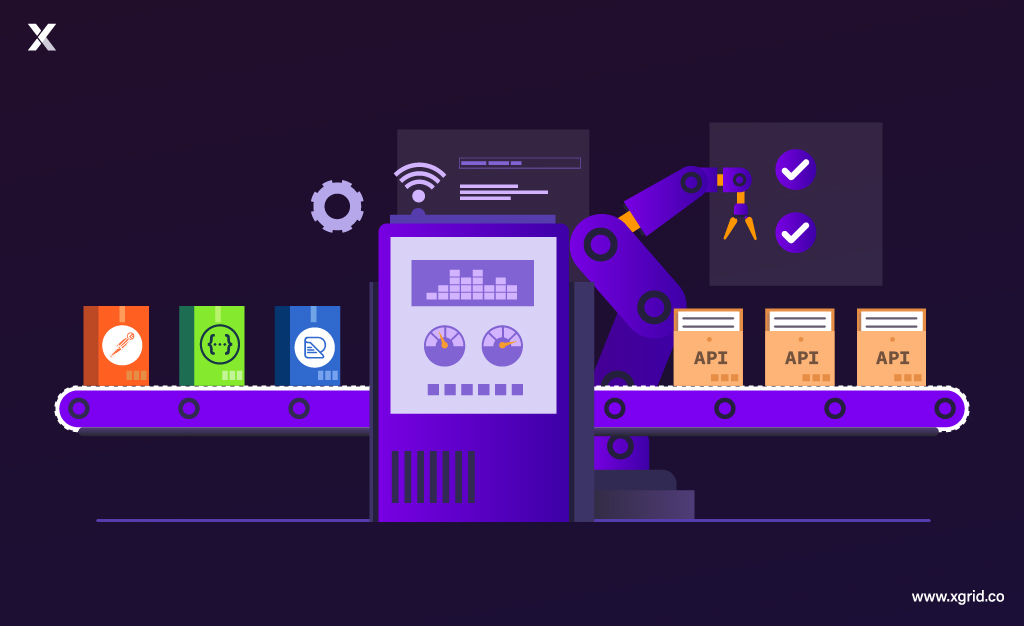
Many text editors and API Documentation tools are traditionally used to generate the API content. Selection of the right tool is important to aggregate the experience of the developer when it comes to learning and integrating an API. A few famous tools include Swagger, Postman, and Redoc which are largely used to create, share and test APIs apart from documenting them. Let’s explore all three:

Swagger UI

Swagger UI is the most well-utilized tool for API documentation. It is a web-based interface for visualizing and testing OpenAPI Swagger definitions. Users can input the document in OpenAPI spec, a standard used for API documentation, using YAML or JSON formats to create a well functioning documentation. The beauty of swagger lies within its easy-to-comprehend syntax which when executed, comes with a direct Try it out feature to help the developers explore the URIs directly with just inputting the Host address.

Postman

Another tool for the quick deployment of API documentation is Postman. It also comes in handy for API testing. This quick deployment tool supports multiple languages and its collections are well structured. The collections in Postman are very easy to navigate, making the job much easier for documentation engineers to handle the associated information. Though customization options with Postman are limited, if that’s not the main thing you are looking for then this is your go to tool!

ReDoc

Redoc is an open-source tool for creating attractive and up-to-date API documentation. It can run in your browser but also comes with a React-based renderer with OpenAPI compliance. This solution can be deployed everywhere as per your requirement! The ReDoc functionality is consumed in highly ranked dev portals mainly Twilio and Stripe. The built-in markdown support also allows theme customization.

Putting it all together

Creating an API is easy but creating an API with good DX (developer experience) is hard. An API is only as good as its documentation. It lays the groundwork for all the requests and responses between multiple software intermediaries. APIs are the glue of any software application that allows users to enhance their existing products or services. A well-known rule 3:30:3 in documentation explains that a good API takes 3 seconds to understand what it does, 30 seconds to find the API endpoints and 3 minutes to use the API result. Using these golden principles, the documentation engineers at Xgrid master the art of handling the complexities of API calls based on the client requirements. For better user experience we then incorporate these code files into our custom and in-house build themes. To know more about us, hit us up at sales@xgrid.co

Read more

Migrating DynamoDB Data Across AWS Accounts

Database migration is one of the most critical and common aspects of cloud migration activities that DevOps engineers and cloud experts encounter on a regular basis. DB migration can also be one of the more complex problems to solve in such cases, since in spite of its frequent occurrence, a straightforward solution is not always readily available for it, due to a varying number of use cases and requirements for each customer application. For these cases, DevOps engineers need to think outside the box, be innovative, and develop a custom solution to fulfill the criteria for their specific use case.

In a similar occurrence, a recent development effort for one of our clients called for the migration of DynamoDB tables between two AWS accounts. Considering the extensive catalog of services and functionalities offered by AWS, one would assume they might have provided an inherent functionality to securely create and manage backups of your AWS resources across different AWS accounts and regions, similar to what is currently possible for RDS. However, I soon found out disappointingly that this is not possible. So I began my research for migrating DynamoDB data across AWS accounts.

I assumed that it would be easy to implement as you can probably create a small script to fetch all the data from a source table and make queries to add the data to a destination table. After hours of scouring Google search results, GitHub repositories, and Stack Overflow threads, I was unable to come across an appropriate solution that would work for my use case. The ones that I found struggled to handle tables with a large amount of data. In my case, I was dealing with a specific table that had approximately 200,000 items.

The AWS recommended solution for migrating data in this scenario contained a two step process where data was first exported to an S3 bucket. From this S3 bucket, the data could be either copied over or exported to another S3 bucket in the destination AWS account with the necessary permissions configured. The data could then be imported from that S3 bucket to the destination DynamoDB table to complete the migration process. In theory, these steps seem simple and straightforward right up to the point where you figure out that AWS has not provided any easy way to import data from an S3 bucket to DynamoDB. They do provide a way to export data from a DynamoDB table to an S3 bucket, but in order to import the data, the recommended approach is to use AWS Data Pipeline.

AWS Data Pipeline is a service that sets up an automated pipeline that can be run manually or on a schedule and the pipeline itself utilizes an EMR cluster to perform data migration and data transformation steps. The problem with this approach is that it is not easy to set up and it would definitely incur extra costs on the AWS account as it would deploy some resources in the EMR cluster which are going to be charged for the amount of time they are up and running.

Nevertheless, even with the already provided template to import DynamoDB data from S3, I was not able to setup AWS DataPipeline successfully nor could I get the logs to work in order to figure out what was wrong. At this point, I started looking into alternatives since it seemed that this solution would require more effort and time to make it work. 

A few suggested solutions involving custom Python scripts and Node modules simply fetched the data from a table and added all the entries to another table. This solution did not require the use of any additional AWS resources. So far so good. This seemed like a promising lead. However, as I proceeded with this solution I realized that it started to struggle at scale, with the migration time increasing for tables with more than 200,000 entries. It took around 3-4 hours to transfer 50% of the table entries, which was definitely not ideal. I needed a more optimized solution.

I finally decided to write a script of my own that utilized the asynchronous nature of NodeJS to achieve the desired functionality. The approach I used was to first fetch all items from the table using multiple scan calls until all of the table entries are fetched. I then proceeded to use the BatchWriteItem call to add items to the table; this call imposes a max limit of 25 items at a time. To cater for this limit, I divided the table entries into batches of 25 items and executed the BatchWriteItem call for each batch in an asynchronous manner so that the script does not wait for the response of one batch call to send another one. This approach greatly reduced the execution time of the script. It transferred the data from the table with 200,000 entries within 6-7 minutes, instead of hours.

The next problem I faced was that this BatchWriteItem approach was not certain to process all items and according to the documentation, it sometimes returned a list of unprocessed items. For these unprocessed items, I had to send a request again, which was also done asynchronously. The script would retry batch write calls on all the unprocessed items and wait for all the calls to be completed before checking if there are still some remaining unprocessed items. This process was repeated until all items were processed successfully and all entries from the source DynamoDB table were migrated to the destination table in a different AWS account. In between each retry call, an exponential backoff algorithm was implemented, a recommendation from AWS documentation. The algorithm works by introducing a small delay between each retry call and it would double the delay time after each retry. For example, if we start with a one second delay after the initial attempt at retrying the batch calls, then before the second attempt, there will be a two second delay, and in the next retry, there will be a four second delay, and so on.

For better understanding, the diagram below shows the complete workflow of the script:


In order to save fellow developers out there facing a similar problem, we have decided to open source the code for this interesting, unique, and highly efficient solution. The script has been developed by Xgrid in collaboration with our partner company, copebit AG. The code for the script is available in this GitHub repository.

We are planning to further optimize this script in the future and will also publish an NPM package for this solution so that it is modular and simple enough to be used by anyone. Further enhancements will be adding a CLI tool within the NPM package to make it even easier to consume.

Our team regularly faces interesting scenarios in our day to day activities while developing custom solutions and applications for our customers on AWS and other cloud environments. We plan on writing a series of blogs on other similar solutions that we have developed and are open sourcing in the future to share our exciting experiences and insights with other developers so that they can take advantage of these tools or solutions and enhance them for their own use cases and requirements.

About Xgrid

Xgrid is an IT services and cloud consulting company that has been working in the areas of Test Automation, Continuous Integration/Delivery, Workflows and Process Automation, Custom Application and Tool Development (with end-to-end UX design and UI development); all tied to private, public and hybrid clouds since it was founded in 2012. Xgrid specializes in the above verticals and provides best-in-class cloud migration, software development, automation, user experience design, graphical interface development and product support services for our customers’ custom-built solutions.

For more details on our expertise, you can visit our website.

About copebit AG

copebit AG is an innovative and dynamic Swiss IT company that focuses on Cloud Consulting and Engineering. Besides their requirement to always master the latest Cloud portfolio, copebit also offers project management from the classic way to the versatile world of agile methods.

For more details on their expertise, you can visit their website.

Read more

Software Quality Assurance – A Critical Cog in the Software Clockwork

Did you know that Quality Assurance (QA) dates back to the Medieval Guilds of Europe that developed and enforced strict rules for product quality? It wasn’t until World War II when statistical quality control techniques were implemented to test ammunition for performance. Read it for yourself. Nowadays, it is assumed that the only purpose of QA is to report potential errors at the end of the development cycle just before the product is released: a common misconception.

While textbooks and academic courses might tell you that Software Quality Assurance (SQA) is a manual or automated testing process at the end of the development cycle to ensure a quality release/ product, this is just not true. An increasing number of conglomerates and companies have realized that SQA is a mindset which introduces several activities and processes throughout the development cycle. It is a continuous and ongoing cycle which is deeply integrated with software development to guarantee high quality. Contrary to popular belief, SQA engineers do not just test systems and report bugs.

“Software quality needs to be seen at a wider perspective relating to “goodness”. Looking beyond the explicit requirements into the realms of product risks and investigation of unknowns, determining the amount of delight or despair the customer will have while using the software. That is to say, the scale of how good (or bad) the software is to use”

– Dan Ashby writes in his blog.

On top of corroborating a bug free release/ product, SQA practices make sure that the software being developed meets the quality standards of coding practices, adheres to defined compliances and general industry standards, all-the-while meeting the client requirements.

For an effective quality assurance of the software, QA engineers are involved in the planning stages of the Software Development Life Cycle (SDLC). They are part of the process wherein the customer requirements are analyzed and the implementation plan is developed. Early involvement and continuous participation of SQA engineers warrants an effective and comprehensive testing. They explore ways to automate the test cases while the feature/ software is being developed. Additionally, these experts also ensure code and product quality, and maintain records and documentation. Furthermore, they manage the impact of changes in the software which includes updating the test plan to incorporate the changes. Thus, SQA is an important cog in the Continuous Integration Continuous Development, and Continuous Deployment (CI/CD) process.

An effective SQA process reduces the number of defects in the final product, guarantees stability, and satisfies client requirements, resulting in an improved customer satisfaction and decreased maintenance cost of the product. The QA process lessens the chances of re-work, provides a sense of predictability, and saves time and money. 

How Our SQA Experts Do It

Among many ways to ascertain the quality for any product or release, there are methods in which Xgrid’s Quality Assurance experts ensure premium quality deliverables:

Shift Left Approach

Shift left testing is quickly becoming the industry standard wherein the QA team is involved in the software development cycle from the very beginning. Our testing and validation cycles are initiated concurrently with the analysis of client requirements. We follow this approach to identify bugs and issues at an early stage. This tactic reduces the development cost, thus increasing efficiency, customer satisfaction, and drastically expediting the development process.


Communicate Effectively and Timely

Communication is the key. While delivering a quality product in a short time-span, Xgrid makes sure that the engineering techniques are paired up with effective and timely communication to accelerate productivity and efficiency among the SQA and Dev teams. In all phases of SDLC, Quality Assurance and Developers’ teams at Xgrid are kept well-informed of any changes or new requirements. Our prompt, clear and focused feedback results in minimized confusions and promotes professional growth. 

Take Your Time to Test

Xgrid’s QA team does not test the application in haste. Instead, we take our sweet time with it because we realize that ensuring the best quality of a service/ product is not a race to be won. Rather, it is a continuous progressive cycle. Rushing the execution of test cases in a crunched timeline can have a negative impact on the quality of deliverables. We carry out Smoke and Sanity test cycles to make sure that major features are not broken. Additionally, minute details and non-critical functionalities are tested as per the available timeline.

Be the Tester End User

We, at Xgrid, wear the tester’s hat when testing an application’s functionality. However, when we  test for usability, our experts walk a mile in the end user’s shoes. Feature development and testing go hand-in-hand. We realize that if our testers do not use the developed feature as per the end user’s needs, the quality of the deliverables may be affected. 

To put things into perspective, let’s take a simple login page example: The user enters login credentials to proceed. The validation checks are added. The “Forgot Password” button works fine. Everything seems to be okay. But there is a high chance that when the user presses the back button, the credentials previously entered are pre-filled on that screen i.e. the fields have not been cleared.  In this case, the feature development is complete, validations are added, and the feature itself is QA verified. But this scenario, which is a normal end user behavior, leads to serious security threats.

User interaction with the feature is as crucial as its proper functioning. For this matter, the internal QA builds are tested as release candidates and the application is thoroughly tested keeping business needs in mind. 

Test the Product According to Its Maturity

Product maturity plays an important role in testing. A growing product undergoing major changes needs to be tested in all aspects. With repetitive test cycles, we radically reduce the number of bugs which results in a stable quality product. We follow the three stages of product maturity defined in Leading Quality

Validation: At this stage, the product is rigorously tested to be a good market fit and be stable on its own. Our approach here is to test the major user workflows without any critical bugs. We opt for manual testing in this phase since automation is not a priority because of the high development cost.

Predictability: This is the  stage where a product is stable in its major workflows and growing in terms of its users. The product becomes predictable at this point and therefore, this is the right time to predict any bugs that may occur due to development in the future. Our testing approach is detailed and exploratory. Automation is also introduced to run the regression test cycles.

Scaling: In this phase, the software is growing in the existing user scale. Even a minor bug can adversely impact a large number of users. There is an increased focus on scale and load testing. We test the product in detail to avoid even the smallest bugs and to increase its performance. This is a good time to look into the optimizations of battery, CPU and GPU consumption. Effective QA strategy is crucial at every stage, and given the nature of the product, a combination of these test approaches is also used.


SQA is a systematic process very similar to the software development life cycle. Development and testing cycles must be defined early on. The endless tasks of the SQA engineers are inclusive of but not limited to quality inspection, test case automation, code and product quality checks etc. They are the champions of monitoring every phase of the development process whilst adhering to company standards. Xgrid is a software company that delivers agile end-to-end testing solutions which reduce costs and increase efficiency, ergo, we deliver better digital products faster. So if you want to enhance your product quality without losing momentum, contact us at sales@xgrid.co.

Read more

Hear Ye: X96’s First Press Release is on ProPakistani

Xgrid – a prominent name in the tech industry of Pakistan announced the launch of its newest brand X-96! A digital marketing and design studio with an ambition to augment creativity, quality, and innovation

Whether you need more brand visibility, customer engagement, or a hike in sales, this dynamic venture has it all! X-96 is a full-service digital marketing and design studio that caters to all aspects of your branding needs from initial conceptualization to building an impactful digital presence and creating a wholesome experience for your customers. 

“We have the strategy, tools, and team spirit to make it happen
for your brand”

– Safwan A. Khan, CEO of Xgrid

“Through X-96, we aim to offer our amazing marketing skills to the world. We have a wealth of experience in this domain, having worked on various marketing projects with a diverse array of clients worldwide. The set of services that we will be offering include design studio, digital marketing, website development, technical writing, and much more!”


Talking about the services being offered by X-96, the team said they have the expertise to provide customers with a great digital experience by crafting brilliance that stands out from the crowd and makes their brand the next sensation!


The emergence of this state of the art Digital Marketing and Design Studio has taken the global clients of Xgrid by storm and X-96 is gaining rising popularity in the local and global industry for its quality services and end to end marketing solutions that meet global standards.  For more information, check out this blog post Introducing X-96.

On the launch of X-96, the CEO proudly said

“As a team, we are super excited to launch X-96, this platform would provide our current and prospective clients a wealth of MarCom & Design services backed by a deep rooted technical team”

– Safwan A. Khan

X-96 is a promising marketing venture launched under the umbrella of Xgrid. We thank ProPakistani for publishing our story.

Read more

Native or Cross-Platform Application Development: That Is the Question

Plethora Plethora of app options these days, no? Nowadays, our smartphones carry a profuse range of applications for just about everything. Gone are the days of hanging billboards, hailing a cab, or searching for rental apartments in the Sunday newspaper. Today, there are 4.4 million apps available on App Store and Google Play to meet our everyday requirements and make lives easier.

“90% of Time on Mobile is spent in Apps”

Source:Agilie

Developing an app is not a walk in the park which is why it requires a robust course of action and copious problem-solving. If you’re a first-time developer about to delve into mobile app development, the first and foremost decision to make is to choose the right platform for your app. This has long-term implications in terms of feasibility, functionality, performance and scalability.

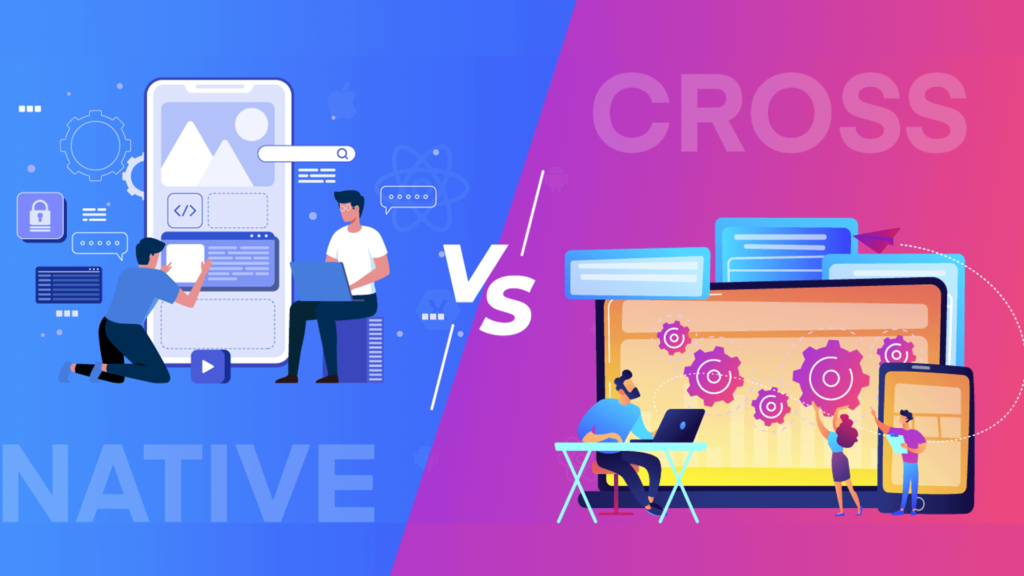
There are two primary approaches for any mobile application: native, and cross-platform. Native app development refers to building a mobile app exclusively for a single platform in a compatible language. For example, a native Android app would require developing with Java and/ or Kotlin. A few app examples for native Android app development include Slack, Lyft, and Evernote developed in Kotlin. For an iOS app, however, you would use Swift and/ or Objective-C. A few app examples for native iOS app development include LinkedIn, WordPress, and Firefox developed in Swift.

Cross-platform app development intimates the process of creating an app that works on several platforms simultaneously. This is achieved via frameworks like React Native, Xamarin, and Flutter, where the product is deployed on Android, iOS and Windows. A few app examples for Cross-Platform app development include Artsy, Bitesnap, Bunch in React Native; Storyo, Insightly, Skulls of the shotgun in Xamarin; and Google Ads, Xianyu by Alibaba and Hamilton in the Flutter framework.


In 1995, Sun Microsystems created a slogan “Write once, run anywhere” (WORA), or sometimes “Write once, run everywhere” (WORE), to illustrate cross-platform benefits of Java language. True story!

Each approach comes with its own baggage of boon and bane.


So how do you take your pick? Dictated herein are the crucial elements to help you choose one over the other:

What to Consider When Choosing an Approach to Build Your Mobile App

  • Application Complexity and Platform Dependence

    If you are developing a complex application that requires access to low-level APIs like Bluetooth, you’ll want to go with native approach because it guarantees (theoretically) zero limitations on said platform. This is because it is easier for a native application to interact with a specific OS and the device’s hardware. Therefore, getting access to all the services of the device is quite convenient.

    However, if it is an application that does not require access to complex OS-specific features, then cross-platform development is a good choice considering the features of the chosen framework do not pose restrictions.

    Noteworthy: Facebook and Google have launched powerful cross-platform app development frameworks namely, React Native and Flutter respectively, thereby drastically bridging the gap between native and cross-platform applications, making the latter approach a better fit for a much larger scope of applications.

  • Development and Support Feasibility

    The time it takes for you to make an application is significant, especially when you’re on a tight schedule. It’s essential to decide the best framework to utilize when time is of the essence. If you have a short deadline for a relatively plain app, consider cross-platform development. As mentioned earlier, you do not need to work on two separate versions for the application. Instead, a single cycle of development is needed for an app to be released for Android and iOS. On the contrary, native app development will take twice as much time thereby lagging behind in schedule.

    Companies often require a Minimum Viable Product (MVP) for their B2B or B2C apps in the nick of time. Xgrid has worked with such clients and delivered profound applications in a very short time span.

    Choosing an approach depends vastly on your budget as well. Complex native applications cost more to develop and maintain compared to their cross-platform counterparts. If you have a limited budget to work with, cross-platform development is an ideal choice. You’ll save around 30%-40% since only a single codebase will be created for an app that works on both Android and iOS.

  • Performance and UI/UX

    Application Performance is crucial to the success of any application. A decisive factor in good performance of an app is its speed. Native applications offer high speed and better performance, however in some cases the cross-platform approach allows for significant reduction in development cost and time without deterioration in user experience

    “Statistical research shows that an average user won’t wait more than 3 seconds for an app to load.”

    Source: LitsLink

    Nevertheless, if your product mandates outstanding user experience, performance and feature-richness, go for native development. Xgrid has developed an enterprise-level native iPad application, currently deployed in a production environment, engaging around 700 users. The app has a variety of features such as task management and logging, clock ins/outs, daily site reports, and employees’ certification etc. The app is designed to work in both online and offline modes.

    For some audiences, user-friendliness is directly correlated with a complementing app and device interface. Here at Xgrid, our developers find the optimal solution to this problem:

    1. Native Approach: The developers coordinate their actions such that the interfaces of iOS and Android app versions are as identical to the underlying platform as possible.

    2. Cross-Platform Approach: The developers make sure all application elements are recognizable and the product interface itself is intuitive and user-friendly.

  • Audience Reach

    Cross-platform and hybrid applications allow you to reach a wider audience than native programs since they’re targeted at several platforms at once and you’ll be able to establish contact simultaneously with iOS and Android users. As a result, you get a chance to increase your user base in the shortest possible time. This, in no way, implies that native applications do not offer reach on multiple platforms at all. They do, but they take a bit longer to reach the audience on both platforms because their Android and iOS versions are deployed in different timelines.

When to Choose Native App Development

To summarize, pick native development if:

  • You want to take full advantage of the mobile phone’s hardware, resources, and services

  • App responsiveness is uncompromisable for you

  • You want an app that can be easily updated and enhanced with new features in the future (in one platform)

  • Cloud native applications are superior in terms of security, scalability and stability.

When to Choose Cross-Platform App Development

Opt for cross-platform app development if:

  • You want to maximize your reach to the target audience concurrently in multiple platforms 

  • Your application requires an extensive use of third party plugins or integration options

  • You want to test an app blueprint in the market or promote it in a short period of time

That’s a lot of big words, we know. If you are still unsure about the best approach for your application, we can assist you in reaching a decision by taking you forward step-by-step. We realize that each application is unique in nature and needs a special approach. Therefore, we facilitate our customers by modeling a feasibility report taking into account all the features of a particular project, and give advice and consultancy based on these premises, all-the-while keeping in view our client’s budget, time and need for reach. We are a team of highly qualified application developers in both iOS and Android platforms who will analyze your case and recommend what is best to choose: iOS and/or Android native development or cross-platform approach. 

Want to get in touch? Drop us an email at sales@xgrid.co

Read more